
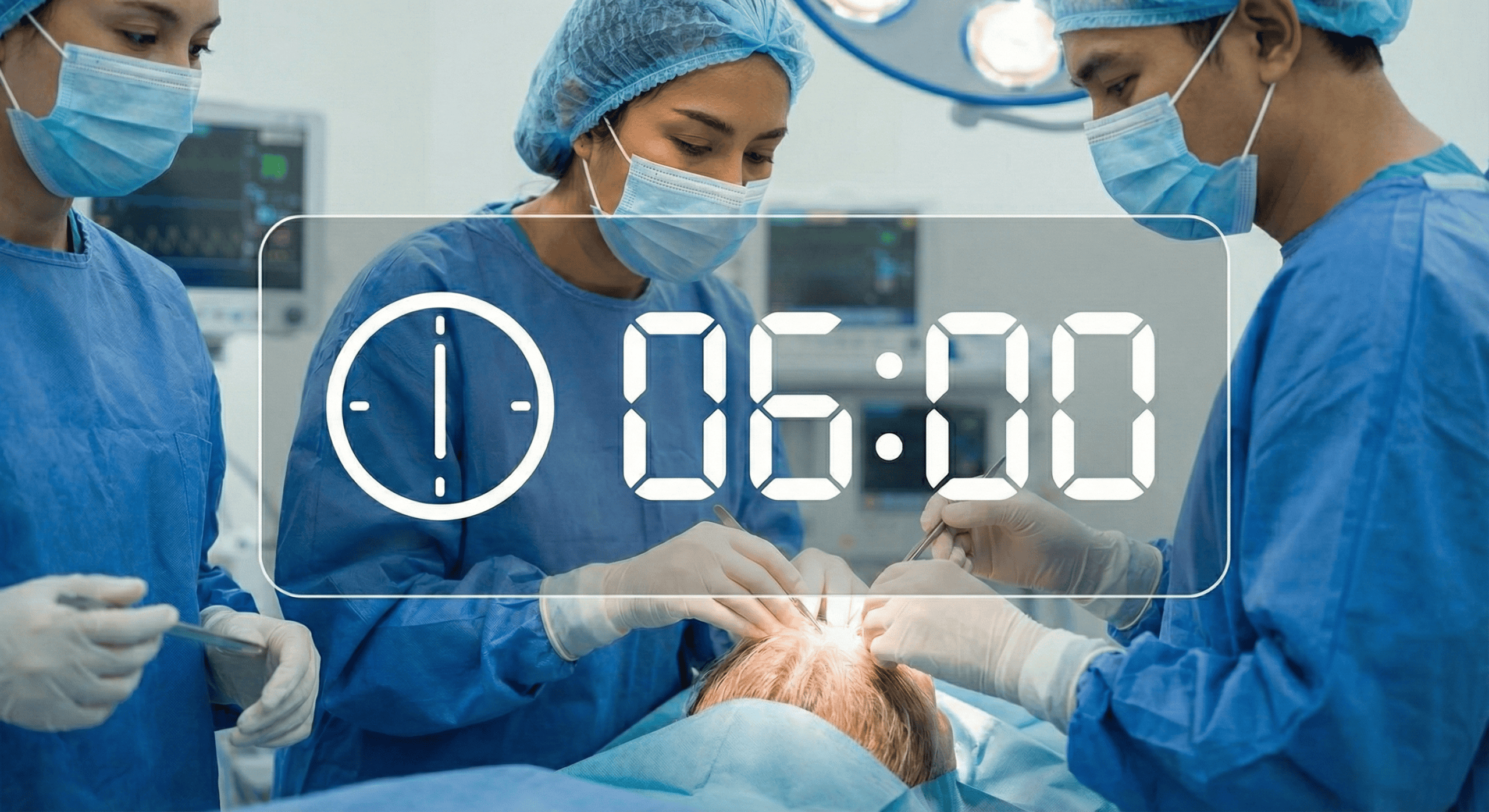
There is a question that every prospective hair transplant patient should ask their clinic, but very few ever do: how long will my procedure take?
It seems like a practical question about scheduling. But in reality, it is one of the most medically significant questions you can ask. Because the answer tells you something critical about how much your clinic values the survival of your grafts.
At Nuttorn Hair Centre, we have built our entire surgical model around a single, non-negotiable principle: no procedure session will exceed six hours in total duration. We call this the 6-Hour Rule, and it is the first pillar of the Nuttorn Protocol.
Understanding why this rule exists, and what happens when clinics don’t follow it, is essential for anyone making an informed decision about where to have their hair transplant.
The Nuttorn Protocol: Four Pillars of Hair Transplant Excellence
| Pillar | Name | Core Purpose |
|---|---|---|
| 1st | The 6-Hour Rule | Maximum graft survival by ensuring no procedure session exceeds 6 hours, keeping every graft within the critical 4-hour out-of-body threshold — with larger cases split across multiple sessions at no extra cost |
| 2nd | 3 Doctors FUI | Three certified surgeons working in rotation for peak freshness and precision, delivering next-generation FUI technique including the Long Hair (Unshaven) Transplant |
| 3rd | ALMI Nanofat Transfer | Supercharge your result — enriching the scalp with your own regenerative stem cells 48 hours after surgery to nourish newly planted grafts, boost thickness, and accelerate recovery |
| 4th | Prevention Is The Best Form Of Protection | Proactive daily post-operative care to prevent complications before they arise and protect the result through recovery |
The Science: What Happens to a Graft Outside the Body
To understand why the 6-Hour Rule matters, you first need to understand what a hair graft actually is, and what happens to it the moment it leaves your scalp.
A hair graft is a tiny unit of living tissue, typically containing one to four individual hair follicles, that is extracted from your donor area and prepared for transplantation into the recipient site. From the moment it is removed from your scalp, the graft is separated from its blood supply. It is, in the most literal sense, a living structure that is slowly running out of time.
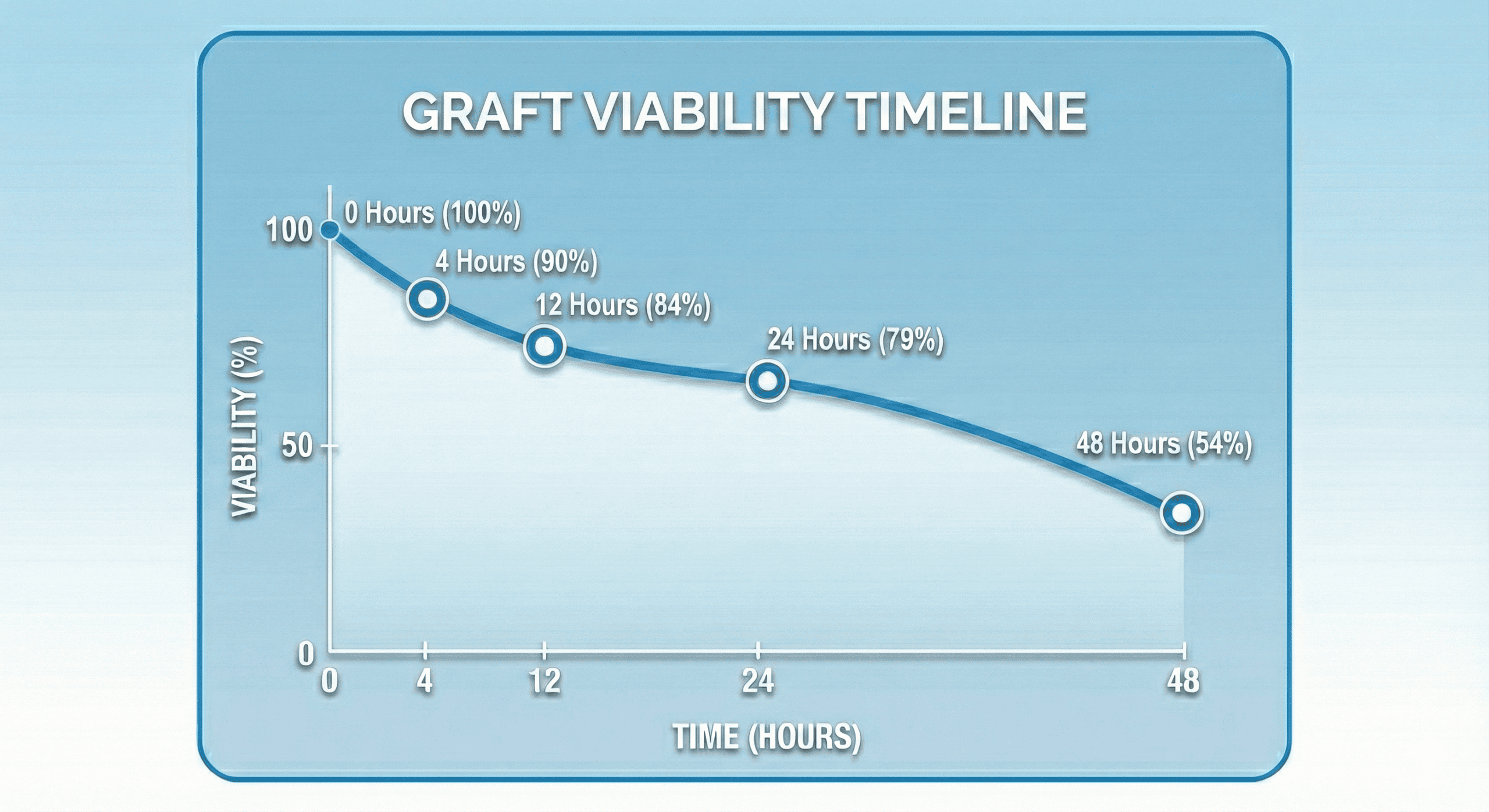
This is not a theoretical concern. The landmark Limmer Study demonstrated definitively that graft viability decreases in direct proportion to the time grafts spend outside the body. The longer a graft is without a blood supply, the lower its chance of successful implantation and long-term survival.
Put simply: every minute your grafts spend outside your scalp is a minute they are dying. The goal of every hair transplant surgeon should be to make that window as short as humanly possible.
The Critical 4-Hour Threshold
Within the 6-Hour Rule sits an even more precise target: the 4-hour out-of-body threshold. This is the point beyond which graft survival rates begin to decline more steeply. Our goal in every procedure is to ensure that no graft spends more than four hours disconnected from the scalp’s blood supply.
A procedure that runs for eight, nine, or ten hours, as is common in clinics that prioritise graft count over graft quality, will inevitably mean that a significant proportion of your grafts have been outside your body for far longer than is scientifically advisable. You may walk away with a high graft number, but a disappointing percentage of those grafts will never grow.
It is not how many grafts you transplant that determines a great result. It is how many of those grafts actually survive and grow. Our 6-Hour Rule exists to maximise that number for every single patient.
— Dr. Nuttorn Narupaves, Nuttorn Hair Centre
What Most Clinics Won’t Tell You About Procedure Length
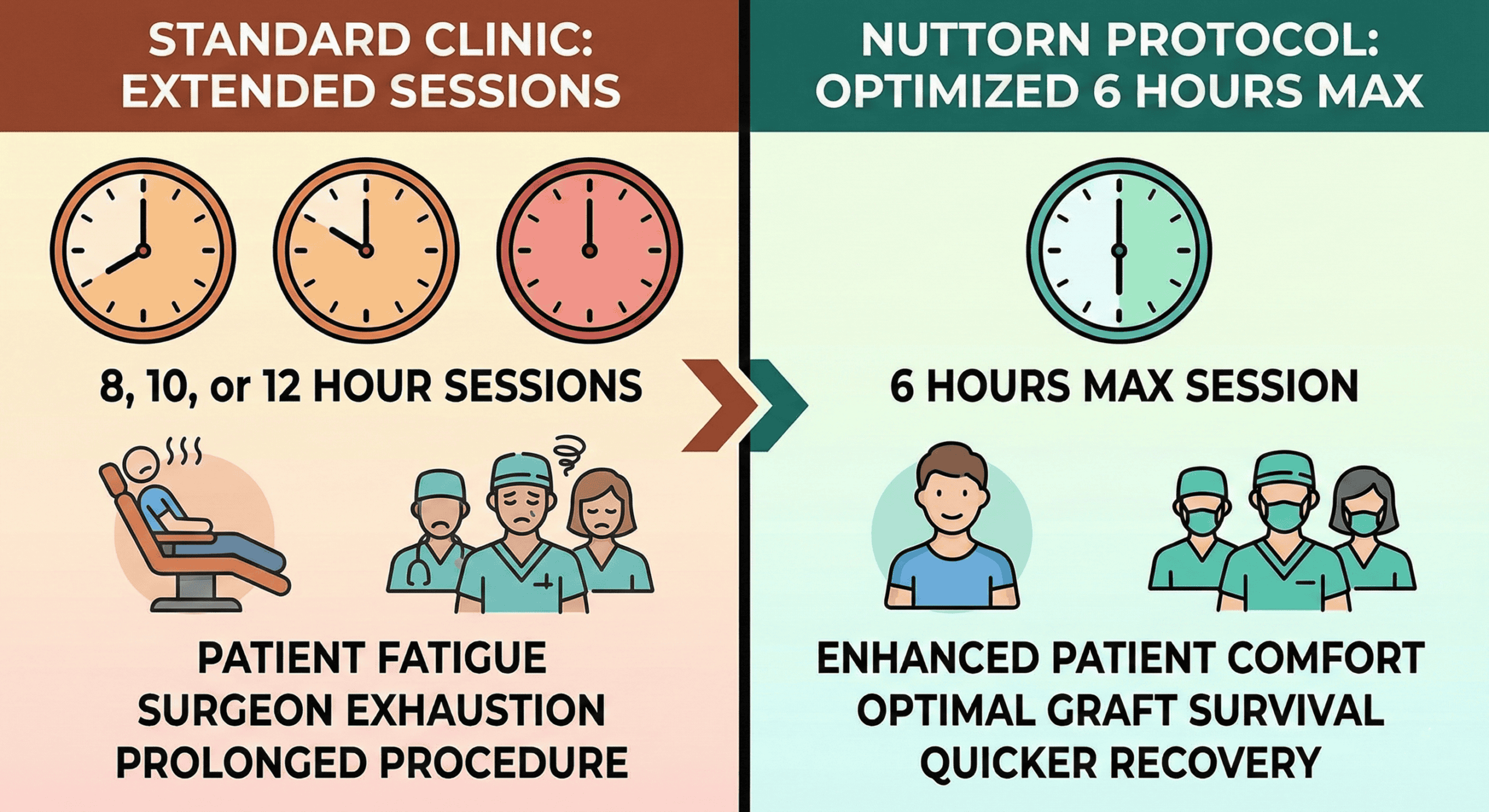
In many clinics, particularly the high-volume hair transplant factories in Istanbul, procedures routinely run for eight hours, ten hours, or longer. This is often presented as thoroughness. In reality, it frequently results from inefficient processes, under-trained staff, or a willingness to prioritise graft volume over graft quality. When a single technician is responsible for implanting thousands of grafts, they simply cannot work fast enough to complete the job within a safe window.
There is also a compounding factor: as sessions extend, fatigue becomes a genuine clinical concern. A technician, or even a surgeon, who has been operating for nine or ten hours is not performing at the same level as one who is fresh. The precision of extraction, the angle of implantation, the delicacy of graft handling, all deteriorate with fatigue.
This is one of the most important reasons patients researching a hair transplant in Thailand over Turkey find their way to Nuttorn Hair Centre. Our 6-Hour Rule is not a marketing claim, it is an enforced surgical discipline that eliminates both time-related graft death and fatigue-driven quality decline. For patients considering a Bangkok hair transplant, it is the foundation on which every other advantage is built.
How We Actually Enforce the 6-Hour Rule: Step by Step
Step 1: Pre-Surgical Assessment and Graft Planning
Achieving the 6-Hour Rule begins well before the operating room. Dr Nuttorn conducts a detailed assessment of your donor density, scalp laxity, and hair loss extent to determine a realistic graft plan, and whether the work can be completed in a single session or should be split across two.
- Set a graft target for each session that is clinically appropriate and achievable within six hours.
- Design the hairline and recipient areas in advance, so surgical time is not consumed by decision-making in theatre.
- Identify donor area characteristics that may affect extraction speed.
- Prepare all materials, solutions, and equipment in advance.
Step 2: The 3 Doctors FUI Technique
The single most important mechanism by which we enforce the 6-Hour Rule is our 3 Doctors FUI technique, the second pillar of the Nuttorn Protocol.
A hair transplant involves distinct physical phases. During extraction, the patient is positioned face down as grafts are harvested from the donor area at the back and sides of the scalp. During implantation, the patient is repositioned face up as grafts are placed into the frontal areas, mid-scalp, and crown.
Our three-surgeon rotation works as follows:
- Each surgeon operates in short, sharp shifts at peak concentration, then rotates out for a break while a colleague takes over.
- The rotation eliminates fatigue-driven decline in quality. The precision of the 2,500th graft placement is maintained at the same standard as the first.
- Every surgeon holds international accreditation and has over a decade of experience at Nuttorn Hair Centre, meaning every hand that touches your procedure operates with the same depth of skill and judgment.
Step 3: Graft Storage and Handling Protocols
- Storage in chilled, isotonic saline solution immediately upon extraction.
- Minimal handling of each graft, every unnecessary contact introduces trauma risk.
- Consistent temperature monitoring throughout.
- A dedicated graft processing team whose sole focus is quality and preservation.
Step 4: Intraoperative Time Monitoring
Our 6-Hour Rule is actively managed throughout every procedure. The team monitors elapsed time against the plan, tracking extraction rate, processing volume, and implantation progress. If the timeline is at risk, adjustments are made immediately.
Step 5: Post-Procedure Graft Assessment
Once implantation is complete, Dr Nuttorn conducts a thorough assessment, reviewing graft placement, angle consistency, density distribution, and overall quality before the patient leaves the operating room.
Why Six Hours? The Number Behind the Rule
The six-hour session limit reliably allows us to maintain the critical 4-hour out-of-body threshold for all grafts, accounting for patient preparation, anaesthetic, extraction, processing, site creation, and implantation.
It also allows us to deliver a genuinely large, clinically meaningful graft count without compromising quality. We are not sacrificing ambition. We are delivering ambition within a framework designed to maximise the chance that every graft actually grows.
Larger Cases: Two Sessions, One Standard
An important question patients often ask is: what happens if my case requires a very large number of grafts? What if 5,000 or more grafts are needed to achieve the coverage I want?
The answer is simple, and it is one of the clearest demonstrations of how seriously we take the 6-Hour Rule: we split the work across two sessions on consecutive days.
For example, a patient requiring extensive coverage might have Session 1 dedicated to the frontal hairline and mid-scalp, and Session 2 the following day dedicated to the crown. Each session is a complete, self-contained procedure, planned, timed, and managed independently, ensuring that no session exceeds six hours and no graft in either session exceeds the critical 4-hour out-of-body threshold.
Critically, we do this at no additional cost to the patient. The decision to split a procedure into two sessions is a clinical decision made in the interest of graft survival and result quality, not a billing opportunity. You pay for the grafts, not the number of sessions.
This approach means that even the most ambitious procedures, cases that other clinics would attempt in a single marathon session of ten or twelve hours, with predictable consequences for graft survival, are delivered at Nuttorn Hair Centre with the same uncompromising adherence to the 6-Hour Rule that defines every case we take on.
I would rather perform fewer procedures and get every one of them right than maximise my schedule and hope for the best. The Nuttorn Protocol exists because I believe every patient deserves a system designed around their result, not around my revenue.
- Nuttorn Narupaves, Founder, Nuttorn Hair Centre
What the 6-Hour Rule Means for Your Results
Higher graft survival rates. More surviving grafts means more hair growth, which is the entire point.
More consistent density. High survival across the procedure means even density rather than patchy areas where grafts have failed.
Better surgical precision throughout. Surgeons who are alert and at the top of their capability.
Greater patient comfort. Six hours respects your time and your body.
Fewer revision procedures. Our 6-Hour Rule is an insurance policy against results that require a second procedure to fix.
The 6-Hour Rule as Part of a Bigger Picture
As the first pillar of the Nuttorn Protocol, the 6-Hour Rule sets the standard for everything that follows.
3 Doctors FUI (Pillar Two) is the surgical mechanism that consistently delivers the 6-Hour Rule. Three certified surgeons working in rotation maintain peak precision throughout, with none of the fatigue that plagues single-surgeon operations.
ALMI Nanofat Transfer (Pillar Three) is administered 48 hours after the procedure to nourish your newly planted grafts with regenerative stem cells and growth factors, supercharging their establishment and boosting long-term thickness and density.
Prevention Is The Best Form Of Protection (Pillar Four) ensures that the foundation the 6-Hour Rule creates, minimal trauma, maximum graft survival, is protected and supported through the recovery phase.
None of these pillars exist in isolation. Together, they form a complete, integrated approach refined across more than 15,000 procedures.
Questions to Ask Any Clinic Before You Book
- How long will my procedure take from first extraction to final implantation?
- What is the maximum time any of my grafts will spend outside my scalp?
- How many surgeons will be operating during my procedure, and what are their specific roles?
- What storage solution do you use for grafts between extraction and implantation?
- How do you manage timing if the procedure is running long?
- Can you show me graft survival rate data or patient results at 12 months?
Frequently Asked Questions
Q: What is the 6-Hour Rule and why does it matter?
A: The 6-Hour Rule is Nuttorn Hair Centre’s non-negotiable commitment that no hair transplant session will exceed six hours in total duration. This ensures every graft stays within the critical 4-hour out-of-body threshold identified by the Limmer Study, maximising graft survival rates and the density of your final result.
Q: What happens to hair grafts that are out of the body too long?
A: Hair grafts are living tissue that begins deteriorating the moment they are separated from your blood supply. The Limmer Study demonstrated that graft viability declines in direct proportion to time spent outside the body. After four hours, survival rates drop more steeply. Clinics that run eight to twelve hour sessions, common in Turkey, are inevitably subjecting a proportion of grafts to damaging out-of-body times.
Q: What is the Limmer Study?
A: The Limmer Study is one of the most cited pieces of research in hair transplant medicine. It established the relationship between graft out-of-body time and survival rates, demonstrating that the longer follicular units spend disconnected from blood supply, the lower their chance of successful growth after implantation. It is the scientific foundation for our 6-Hour Rule.
Q: What if I need more grafts than can be done in six hours?
A: For larger cases requiring 5,000+ grafts, we split the work across two sessions on consecutive days. For example, Session 1 might cover the frontal hairline and mid-scalp, with Session 2 the following day dedicated to the crown. Each session is independently planned and timed under the 6-Hour Rule. This is done at no additional cost to the patient.
Q: Do Turkish clinics follow a similar time limit?
A: No. Hair transplant sessions in Turkey routinely run for eight, ten, or even twelve hours. This is partly because technicians, not surgeons, perform much of the work, operating more slowly. It is also because the volume-driven model prioritises completing high graft counts in a single sitting regardless of the impact on graft survival. The 6-Hour Rule is a direct response to this industry-wide problem.
Q: How does the 6-Hour Rule effect surgeon fatigue?
A: By capping each session at six hours and rotating three certified surgeons through short, focused shifts, we eliminate fatigue-driven quality decline entirely. In a single-surgeon or technician-led operation running eight to ten hours, the precision of extraction and implantation inevitably deteriorates as fatigue accumulates. Our model ensures the surgeon operating at any given moment is fresh and at peak performance.
Q: Does the 6-Hour Rule mean I get fewer grafts?
A: Not at all. Three experienced surgeons working in rotation can achieve a clinically meaningful graft count, typically 3,000 to 4,000 grafts, within a single six-hour session. For patients needing more, our two-session approach delivers 5,000+ grafts across consecutive days with zero compromise on quality. You are not sacrificing ambition, you are protecting it.
Q: How do you store grafts during the procedure?
A: Extracted grafts are immediately placed in a chilled, isotonic saline solution and maintained at a consistent temperature throughout the session. A dedicated graft processing team handles every unit with minimal contact to reduce trauma risk. Temperature and time are monitored continuously to ensure every graft remains within safe parameters.
Q: How does the 6-Hour Rule benefit my recovery?
A: A shorter, more efficient procedure means less time under anaesthesia, less overall trauma to the scalp, and a faster initial recovery. Patients who undergo six-hour sessions report less post-operative swelling and discomfort compared to those who endure marathon procedures. Combined with ALMI Nanofat Transfer at 48 hours, the recovery from a Bangkok hair transplant under the 6-Hour Rule is measurably smoother.
Q: Can I have two sessions if I want to split a moderate case for comfort?
A: Yes. While the two-session approach is typically reserved for larger cases of 5,000+ grafts, some patients prefer to split moderate cases across two days for personal comfort reasons. Dr Nuttorn will discuss this option during your consultation and help you decide what works best for your situation. There is no additional charge for splitting across sessions.
.
Q: How do I know my clinic is actually following a time limit?
A: This is an excellent question to ask any clinic. At Nuttorn Hair Centre, the 6-Hour Rule is actively monitored throughout every procedure with intraoperative time tracking. The surgical team tracks extraction rate, processing volume, and implantation progress in real time and makes adjustments immediately if the timeline is at risk. Ask your clinic: can you guarantee a maximum session time in writing?
Q: What is the graft survival rate at Nuttorn Hair Centre?
A: While individual results vary based on patient factors, our protocol is designed to maximise the conditions for graft survival: strict session timing, surgeon-performed technique, optimal graft storage, and post-operative ALMI Nanofat nourishment. Patients who choose a hair transplant in Thailand at Nuttorn Hair Centre benefit from every one of these advantages working together.
Q: Is the 6-Hour Rule an industry standard?
A: No. The 6-Hour Rule is specific to the Nuttorn Protocol and is not widely practised in the hair transplant industry. Most clinics do not publish or enforce a maximum session time. This is one of the key differentiators that patients identify when comparing a Thailand hair transplant at Nuttorn Hair Centre against clinics in Turkey and elsewhere.
Q: How does a hair transplant under AU$5,000 in Bangkok compare to Turkish pricing?
A: This is an excellent question to ask any clinic. At Nuttorn Hair Centre, the 6-Hour Rule is actively monitored throughout every procedure with intraoperative time tracking. The surgical team tracks extraction rate, processing volume, and implantation progress in real time and makes adjustments immediately if the timeline is at risk. Ask your clinic: can you guarantee a maximum session time in writing?
Experience the 6-Hour Rule for Yourself
For patients considering a Thailand hair transplant, the 6-Hour Rule is the single most important question to ask any clinic: will you guarantee that no session exceeds six hours? At Nuttorn Hair Centre, the answer is always yes.
While Turkish clinics routinely run marathon sessions of eight to twelve hours, with predictable consequences for graft survival, our Bangkok hair transplant procedures are designed around the science of what your grafts actually need to grow. With procedures starting under $5,000, you are not paying more for this standard. You are simply choosing a clinic that prioritises your result over its convenience.
Your hair transplant result is a lifetime investment. Make sure the clinic you choose treats it that way.