

If you have been researching hair transplants for any length of time, you have almost certainly encountered two technique acronyms that dominate the conversation: FUE and DHI. You may have spent hours trying to understand the difference between them, debating which one is right for you, and reading conflicting opinions from clinics each claiming their preferred method is superior.
At Nuttorn Hair Centre, we have moved beyond that debate entirely. Because FUI, Follicular Unit Implantation, is not FUE, and it is not DHI. It is the next generation of hair transplant technique, born from the best elements of both.
And when three internationally certified surgeons perform it together, rotating through short, focused shifts that keep every doctor fresh and operating at their peak, the result is something the industry has never seen before: a procedure so efficient, so precise, and so patient-centred that it makes every previous approach look like a stepping stone to where hair transplantation was always headed.
This is 3 Doctors FUI, the second pillar of the Nuttorn Protocol, and the surgical engine that powers everything we deliver.
The Nuttorn Protocol: Four Pillars of Hair Transplant Excellence
| Pillar | Name | Core Purpose |
|---|---|---|
| 1st | The 6-Hour Rule | Maximum graft survival by ensuring no procedure session exceeds 6 hours, keeping every graft within the critical 4-hour out-of-body threshold — with larger cases split across multiple sessions at no extra cost |
| 2nd | 3 Doctors FUI | Three certified surgeons working in rotation for peak freshness and precision, delivering next-generation FUI technique including the Long Hair (Unshaven) Transplant |
| 3rd | ALMI Nanofat Transfer | Supercharge your result — enriching the scalp with your own regenerative stem cells 48 hours after surgery to nourish newly planted grafts, boost thickness, and accelerate recovery |
| 4th | Prevention Is The Best Form Of Protection | Proactive daily post-operative care to prevent complications before they arise and protect the result through recovery |
Understanding the Landscape: FUE, DHI, and the Gap Between Them
If you have been researching a FUE hair transplant in Thailand or a DHI hair transplant in Thailand, you have already encountered the two techniques that dominate the industry conversation. Understanding both, and understanding why neither represents the final word, is essential to making an informed decision.
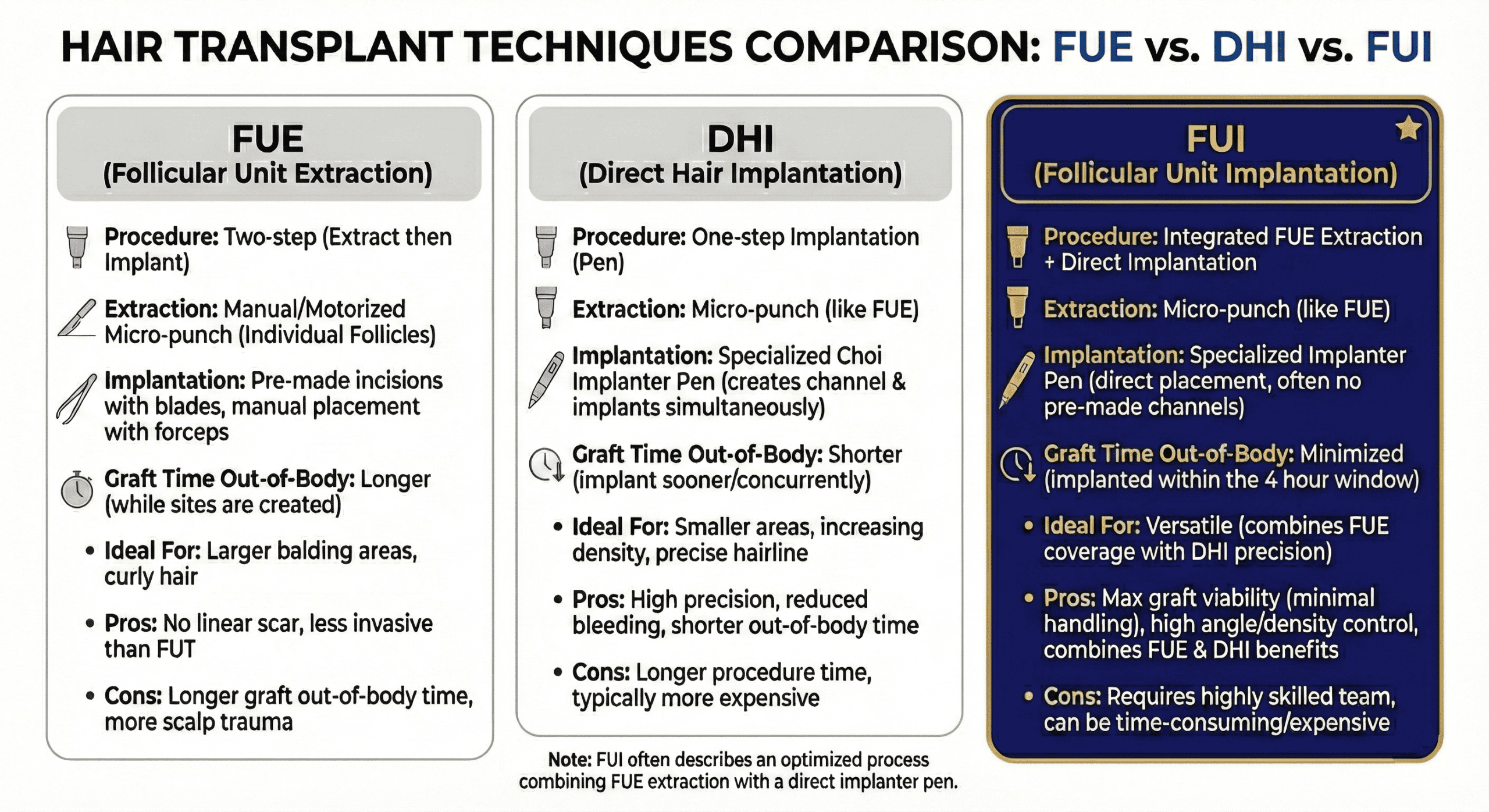
FUE, Follicular Unit Extraction revolutionised hair transplantation when it emerged as an alternative to strip-harvesting (FUT). Rather than removing a strip of scalp, FUE uses a micro-punch tool to extract individual follicular units one by one. This eliminated linear scarring and improved recovery times. FUE remains the most widely marketed technique in Turkey and across Asia.
DHI, Direct Hair Implantation took a different approach to implantation. Rather than creating recipient sites then placing grafts as a separate step, DHI uses a Choi implanter to simultaneously create the channel and implant the graft in a single motion.
Both represented meaningful advances. But each carried limitations, particularly when it came to one specific patient desire: the ability to have a hair transplant without shaving your head.
What Is FUI? Follicular Unit Implantation Explained
FUI, Follicular Unit Implantation, takes the best of FUE and DHI and combines them into a single, superior approach. It retains the precision extraction of FUE while incorporating the direct implantation advantages of DHI, but it goes further than either.
The most significant advancement is its compatibility with the revolutionary Long Hair (Unshaven) Transplant, a procedure that was not consistently achievable with earlier techniques at a clinically meaningful scale.
FUI’s refined implantation mechanism allows surgeons to work with precision through existing hair, without needing to shave, clip, or cut a single strand.
The Long Hair (Unshaven) Transplant: A Revolution in Patient Experience
For decades, one of the most significant deterrents to hair transplant surgery was the requirement to shave the head. For many patients, this was a deal-breaker. The Long Hair (Unshaven) Transplant, made possible by FUI, changes this completely.
- Attend your procedure with your hair exactly as it normally is, no shaving, no cutting, no clipper work.
- Leave the clinic with existing hair covering the treated areas, virtually invisible from day one.
- Return to work and normal life far sooner, often within days.
- See an immediate preview of your final result, since transplanted long hairs are visible immediately.
- Avoid the psychological distress of the shaved appearance.
For patients travelling from Australia and other international destinations, this advantage is amplified enormously. Flying home days after a long hair transplant in Bangkok with no visible evidence of surgery is a fundamentally different experience from the shaved-head recovery that FUE and DHI procedures in Turkey typically require.
Why Three Doctors? The Power of Rotation
FUI is a technically demanding procedure. Its precision requirements, particularly as a Long Hair (Unshaven) Transplant through existing hair, demand a level of focus that cannot be sustained by a single surgeon across an entire procedure.
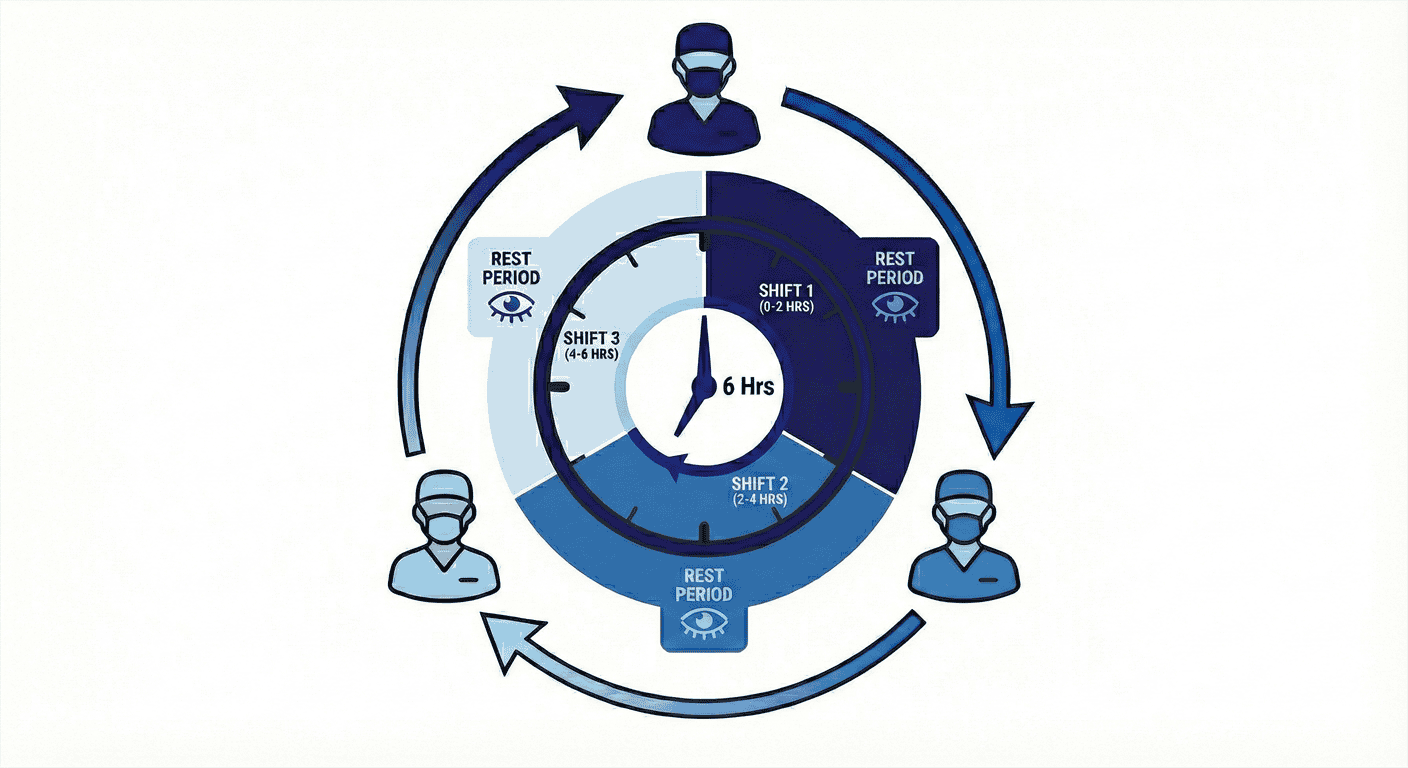
This is the insight at the heart of 3 Doctors FUI: the best hair transplant is not one performed by one surgeon growing progressively fatigued. It is one performed by three excellent surgeons, each taking short, focused shifts at the peak of their ability before rotating out for a break.
We call this the power of rotation. Like relay runners handing off at precisely the right moment, each surgeon enters fresh and leaves before fatigue can affect their precision.
"One surgeon performs a procedure. Three surgeons perform a protocol. The difference is not just efficiency, it is the difference between good and exceptional."
— Dr. Nuttorn Narupaves, Nuttorn Hair Centre
How the Rotation Works: Freshness, Experience, and Precision
The Phases of Surgery
A hair transplant involves distinct physical phases. During extraction, the patient is positioned face down as grafts are harvested from the donor area at the back and sides of the scalp. During implantation, the patient is repositioned face up as grafts are placed into the recipient areas, typically the frontal hairline first, then mid-scalp and crown, with the donor area elevated to avoid irritation.
Short, Sharp Shifts at Peak Performance
- Each surgeon operates for a concentrated period at their absolute peak, then rotates out for a rest break.
- No surgeon is ever operating in a state of accumulated fatigue.
- The rotation covers every phase, extraction, graft processing, recipient site creation, and implantation, with each surgeon bringing the same depth of skill.
- The quality of the 2,500th graft placement matches the first.
Why Surgeons, Not Technicians
At many clinics, particularly in Turkey, the world’s highest-volume hair transplant destination, the hands performing the most demanding work are not surgeons at all. Turkey’s hair transplant industry is notorious for a specific model: a famous surgeon lends their name and reputation to the clinic, but on any given day they are ‘supervising’ multiple surgeries happening simultaneously in adjacent rooms. The surgeon may design your hairline, appear briefly, then move to the next patient. The actual extraction and implantation, the work that determines your result, is performed by technicians.
This is the standard model for FUE hair transplant and DHI hair transplant procedures across Istanbul. It is how clinics keep prices low while processing dozens of patients per week. And it is the single biggest reason that patients researching a Thailand hair transplant find their way to Nuttorn Hair Centre.
At Nuttorn Hair Centre, every procedure is 100% surgeon-performed. Here is why that matters:
- Hair transplant technicians are rarely lifers. This is not their long-term career, if it were, they would likely have become surgeons. They do not accumulate the same depth of experience or drive for continuous learning.
- It is uncommon for a technician to remain in hair transplant work for ten, fifteen, or twenty years. Almost all our surgeons have over a decade of experience with Nuttorn Hair Centre alone.
- Technicians do not hold international accreditation or training. Our surgeons hold certifications across multiple jurisdictions, credentials no Turkish clinic can match.
- The accumulated experience of a career surgeon translates directly into speed and precision. What takes a technician eight hours takes our surgeons six, and the quality is incomparably higher.
When patients ask whether to choose Thailand not Turkey for a hair transplant, the technician question is often the deciding factor. At Nuttorn Hair Centre, the answer is unambiguous: three certified surgeons, in the room, performing your procedure personally. Every graft, every time.
How 3 Doctors FUI Makes the 6-Hour Rule Possible
The connection between the second and first pillars is architectural. Consider a single-surgeon procedure: one doctor must maintain intense focus through hours of extraction (patient face down), then transition to implantation (patient face up), all while concentration gradually erodes. For 2,500+ grafts, this almost inevitably extends procedure time or results in declining quality.
Now consider a clinic relying on technicians. A technician with two or three years of experience simply does not possess the speed or precision of a surgeon with over a decade of dedicated work.
The 3 Doctors FUI model solves both problems. Three experienced surgeons rotating through focused shifts means no fatigue, no quality decline, and the speed that only comes from deep expertise.
The 6-Hour Rule sets the standard. The 3 Doctors FUI technique is the precision engineering that meets it.
Internationally Certified: The Credentials Behind 3 Doctors FUI
Our surgical team holds certifications from:
- The American Board of Hair Restoration Surgery (ABHRS)
- American Academy of Aesthetic Medicine
- The London Hair Restoration Training Academy
- St Louis University, USA
- Cardiff University, UK
- The International Society of Hair Restoration Surgery (ISHRS)
When all three surgeons are certified specialists with over a decade of experience, every shift in the rotation is held to the same uncompromising standard.
What 3 Doctors FUI Means for Your Result
Higher graft survival. Every phase performed by a fresh, focused surgeon maximises the proportion of grafts that survive and grow.
Natural density and distribution. Fresh surgeons rotating through implantation ensure consistent angle and depth for natural growth patterns.
Freedom from shaving. FUI’s Long Hair (Unshaven) Transplant means no visible evidence of surgery from day one.
Consistent quality throughout. No fatigue-driven deterioration in the second half of the procedure.
A shorter, more comfortable procedure. Three experienced surgeons complete each session within six hours.
Peace of mind. Every person working on your procedure holds international surgical certification.
A Closer Look: The Long Hair Transplant in Practice
Before: You arrive with your hair exactly as it is. No alteration required.
During: Local anaesthetic is administered. Extraction begins with the patient face down. Once complete, you are repositioned face up and implantation begins through your existing hair. Three surgeons rotate through focused shifts. Your hair remains at its natural length throughout.
Immediately after: Transplanted hairs are visible at full length. The treated areas are not visible beneath your existing hair.
48 hours post-procedure: The third pillar activates, ALMI Nanofat Transfer is administered to nourish your newly planted grafts with regenerative stem cells and growth factors, supercharging their establishment.
In the weeks following: Transplanted hairs shed within the first few weeks as follicles enter a resting phase. Your existing hair provides coverage throughout. The full growth cycle begins, supported by the biological benefits of ALMI Nanofat.
Questions to Ask Any Clinic Before You Book
- How long will my procedure take from first extraction to final implantation?
- What is the maximum time any of my grafts will spend outside my scalp?
- How many surgeons will be operating during my procedure, and what are their specific roles?
- What storage solution do you use for grafts between extraction and implantation?
- How do you manage timing if the procedure is running long?
- Can you show me graft survival rate data or patient results at 12 months?
3 Doctors FUI as Part of the Complete Protocol
Questions to Ask Any Clinic About Their Technique
- Who exactly will be performing extraction and implantation, a certified surgeon, or a technician?
- Do you offer a Long Hair (Unshaven) Transplant option?
- How many surgeons will be present and active during my procedure?
- What is your average total procedure time for my graft requirements?
- What is your graft out-of-body time during a typical procedure?
- Can I see results from patients with similar hair type and loss pattern?
Frequently Asked Questions
Q: What exactly is FUI and how is it different from FUE?
A: FUI, Follicular Unit Implantation, takes the precision extraction of FUE and combines it with the direct implantation advantages of DHI. The key advancement is that FUI enables the Long Hair (Unshaven) Transplant at clinically meaningful scale, something standard FUE cannot consistently achieve. If you are researching a FUE hair transplant in Thailand, FUI is the next-generation evolution.
Q: What is the Long Hair (Unshaven) Transplant?
A: The Long Hair Transplant allows you to have a complete hair transplant without shaving or cutting your hair at any point. You arrive with your hair as it normally is, and you leave with existing hair covering the treated areas. Transplanted long hairs are visible immediately, giving you an instant preview of your final result. This is one of the most requested features of a Bangkok hair transplant at Nuttorn Hair Centre.
Q: Do all three surgeons work on my procedure at the same time?
A: No. The three surgeons work in rotation, not simultaneously. Each surgeon takes a short, focused shift at peak concentration, then rotates out for a rest break while a colleague takes over. This relay-style approach eliminates fatigue and ensures the surgeon operating at any given moment is completely fresh. It is fundamentally different from a single surgeon working for the entire duration.
Q: Why do other clinics use technicians instead of surgeons?
A: Economics. Technicians cost clinics significantly less than qualified surgeons, allowing higher profit margins per procedure. In Turkey, the dominant model is for a named surgeon to design the hairline and supervise from a distance while technicians perform extraction and implantation, often across multiple patients simultaneously. At Nuttorn Hair Centre, we believe the hands on your scalp should belong to internationally certified surgeons. Every graft, every time.
Q: How experienced are the three surgeons?
A: Each surgeon in our rotation has over a decade of dedicated experience at Nuttorn Hair Centre and holds international certifications from institutions including the American Board of Hair Restoration Surgery, the London Hair Restoration Academy, St Louis University, Cardiff University, and the International Society of Hair Restoration Surgery. This depth of combined experience is unmatched by any clinic in Turkey or across Asia.
Q: Can I choose to have a traditional (shaved) transplant instead?
A: Absolutely. While the Long Hair (Unshaven) Transplant is our most popular option, some patients prefer or are clinically better suited to a traditional approach. Dr Nuttorn will discuss both options during your consultation and recommend the best approach for your specific hair type, loss pattern, and lifestyle. The same 3 Doctors FUI technique and Nuttorn Protocol apply regardless.
Q: Is FUI suitable for all hair types?
A: Yes. FUI has been successfully performed on a wide range of hair types including straight, wavy, and curly hair across Caucasian, Asian, and Afro-textured hair types. Dr Nuttorn’s experience across more than 10,000 procedures spanning diverse ethnicities means he can adapt the technique to your specific hair characteristics.
Q: How does 3 Doctors FUI make the 6-Hour Rule possible?
A: A single surgeon or technician working alone simply cannot achieve the speed and precision required to complete a meaningful graft count within six hours. Three experienced surgeons rotating through focused shifts combine the speed that comes from deep expertise with the freshness that comes from regular rest. This architectural connection between the first and second pillars is what makes the Nuttorn Protocol work as an integrated system.
Q: What is the Choi implanter and how does FUI use it?
A: The Choi implanter is a pen-like instrument that creates the recipient channel and implants the graft in a single motion, eliminating the need for separate site-creation and graft-placement steps. FUI incorporates the Choi implanter as part of its implantation phase, combining this efficiency advantage with FUE-precision extraction. This dual approach is what enables working through long existing hair without damaging it.
Q: Will there be visible scarring after a FUI procedure?
A: FUI uses micro-punch extraction that leaves tiny dot-like marks in the donor area, which heal to become virtually invisible within weeks. There is no linear scar as with older strip-harvesting (FUT) techniques. The Long Hair Transplant further conceals any temporary marks beneath your existing hair. Most patients report that even close friends and family cannot tell they have had a procedure.
Q: How does the Long Hair Transplant work if my hair is thinning?
A: Even with moderate thinning, most patients have sufficient existing hair to conceal the treated areas during recovery. Dr Nuttorn assesses your specific situation during consultation to confirm you are a suitable candidate. For patients with advanced hair loss who may not have enough coverage, a traditional approach may be recommended instead. The goal is always the best clinical outcome for your situation.
Q: How soon after a FUI transplant can I return to work?
A: Many Long Hair Transplant patients return to work within 3–5 days of surgery, as the treated areas are concealed beneath existing hair. Traditional (shaved) transplant patients typically allow 7–10 days depending on their comfort level. We recommend spending 3–4 days in Bangkok for your recovery under Dr Nuttorn’s direct care before flying home.
Q: Is FUI more expensive than standard FUE or DHI?
A: No. Hair transplant pricing at Nuttorn Hair Centre starts under $5,000 regardless of whether you choose the Long Hair or traditional approach. You are not paying a premium for FUI, it is our standard technique for every patient. Compare this to Turkish clinics where basic FUE packages start at similar prices but are performed by technicians with no published protocol.
Q: Can FUI be combined with other treatments?
A: Yes, and in fact this is central to the Nuttorn Protocol. Every FUI procedure at Nuttorn Hair Centre is followed by ALMI Nanofat Transfer at 48 hours (the third pillar) and supported by our daily prevention programme (the fourth pillar). This integrated approach is one of the key reasons patients choose a hair transplant in Thailand at Nuttorn Hair Centre over standalone FUE or DHI procedures elsewhere.
Q: What if I have had a previous hair transplant at another clinic?
A: Dr Nuttorn regularly treats patients who have had previous procedures elsewhere, including those dissatisfied with results from Turkish clinics. FUI can work around existing transplanted hair and scar tissue. During consultation, Dr Nuttorn will assess your donor availability, existing graft placement, and what can realistically be achieved with a revision procedure under the Nuttorn Protocol.