When most people think about hair transplant success, they think about the surgery itself, the precision of the incisions, the number of grafts, the hairline design. And while those things matter enormously, what happens in the days after your procedure is equally critical to achieving the results you came for. This is why patients choosing a hair transplant in Thailand over Turkey find the Nuttorn Protocol so compelling: our commitment to your result does not end when surgery is complete.
At Nuttorn Hair Centre, we have built our philosophy around a four-pillar framework we call the Nuttorn Protocol. Each pillar exists because we believe that exceptional results don’t come from surgery alone, they come from a complete, end-to-end commitment to doing things right.
The first pillar is our 6-Hour Rule, ensuring no procedure session exceeds six hours so that grafts are never out of the body long enough to compromise their survival. The second pillar is our 3 Doctors FUI technique, three certified surgeons working in rotation to maintain peak freshness and precision. The third pillar is ALMI Nanofat Transfer, a concentrated dose of your own regenerative stem cells and growth factors administered 48 hours after surgery to nourish your newly planted grafts.
And the fourth pillar, the focus of this article, is perhaps the most overlooked of all: Prevention Is The Best Form Of Protection.
The Nuttorn Protocol: Four Pillars of Hair Transplant Excellence
| Pillar | Name | Core Purpose |
|---|---|---|
| 1st | The 6-Hour Rule | Maximum graft survival by ensuring no procedure session exceeds 6 hours, keeping every graft within the critical 4-hour out-of-body threshold — with larger cases split across multiple sessions at no extra cost |
| 2nd | 3 Doctors FUI | Three certified surgeons working in rotation for peak freshness and precision, delivering next-generation FUI technique including the Long Hair (Unshaven) Transplant |
| 3rd | ALMI Nanofat Transfer | Supercharge your result — enriching the scalp with your own regenerative stem cells 48 hours after surgery to nourish newly planted grafts, boost thickness, and accelerate recovery |
| 4th | Prevention Is The Best Form Of Protection | Proactive daily post-operative care to prevent complications before they arise and protect the result through recovery |
Why Post-Operative Prevention Matters More Than You Think
A hair transplant is a surgical procedure, and like all surgery, the recovery phase carries its own set of risks. The grafts have been transplanted, the incisions are healing, and your scalp is in a vulnerable state. This is precisely the window where complications tend to surface.
The good news is that the vast majority of post-operative complications are entirely preventable. At Nuttorn Hair Centre, we don’t wait for problems to appear before we act. We build a comprehensive prevention strategy into every patient’s journey from day one.
What makes our prevention programme uniquely effective is that it works hand-in-hand with the third pillar: ALMI Nanofat Transfer. Because ALMI is administered 48 hours after surgery, its anti-inflammatory, pro-healing biological effects are active during precisely the window when complications are most likely to emerge. The prevention programme is not working alone, it is supported by a biological ally that is actively nourishing the scalp and suppressing the conditions that lead to complications.
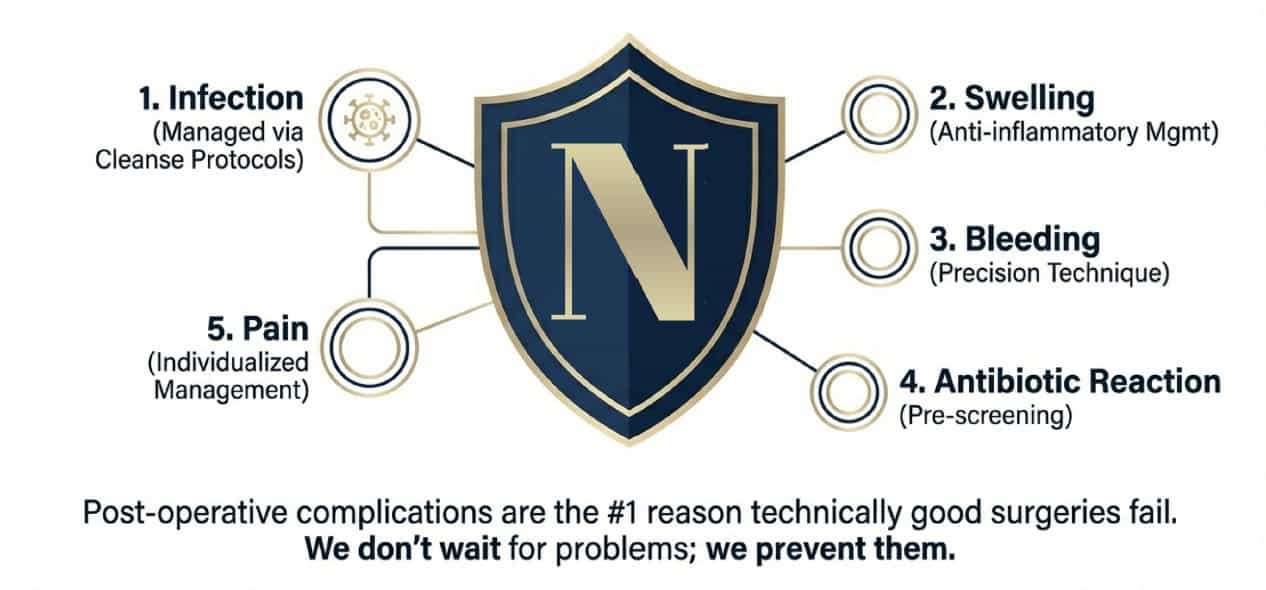
5 Most Common Post Operative Risks & How We Combat Them
1. Donor Area Infection: Clean Technique and Daily Monitoring
Infection typically occurs when bacteria enter the open follicular channels before the scalp has sealed. Poor aftercare, unclean technique, or insufficient follow-up create the conditions for infection.
How we prevent it:
- Daily scalp cleanse sessions by our medical team using medical-grade solutions.
- Sterile surgical environments and strict procedural protocols throughout the operation.
- Daily consultations with Dr Nuttorn so early signs are identified and addressed immediately.
- Clear, personalised aftercare instructions for between clinic visits.
- The ALMI advantage: From 48 hours post-procedure, ALMI Nanofat’s growth factors promote faster closure of follicular channels and a more robust healing response at the tissue level, reducing the window of vulnerability during which infection can take hold.
2. Excess Swelling: Getting Ahead of the Inflammatory Response
Some swelling is normal after a hair transplant. However, excessive swelling can be uncomfortable and in some cases affect graft positioning. It tends to present in the forehead area and can migrate toward the eyes.
How we prevent it:
- Pre-operative anti-inflammatory medications as part of the pre-surgery protocol.
- Post-operative corticosteroid regimens carefully managed and adjusted individually.
- Daily monitoring to assess swelling and intervene early.
- Hydration guidance and activity restriction advice.
- The ALMI advantage: ALMI Nanofat’s concentrated anti-inflammatory cytokines, delivered at the 48-hour mark, actively suppress the inflammatory cascade that drives post-operative swelling. Patients who receive ALMI consistently present with reduced swelling compared to non-ALMI procedures, one of the most tangible examples of how the third pillar directly supports the fourth.
3. Excess Bleeding: Precision Surgery and Pre-Screening
Post-operative bleeding, while uncommon with FUI, can occur if precautions are not observed. Excess bleeding delays healing and can dislodge newly placed grafts.
How we prevent it:
- Pre-procedure medical screening and medication review identifying blood thinners, supplements, and herbal remedies to pause.
- The precision of our 3 Doctors FUI technique minimises scalp trauma during extraction and implantation.
- Clear pre-operative instructions on alcohol avoidance, exercise restrictions, and medication management.
- Post-operative wound assessment during daily check-ins.
- The ALMI advantage: ALMI Nanofat stimulates angiogenesis, the formation of new micro-blood vessels, and strengthens the subcutaneous tissue layer from 48 hours onwards. This improved vascular network means the scalp heals more efficiently, with micro-wounds closing faster.
4. Antibiotic Reactions: Know Before You Go
Not all patients tolerate all antibiotics equally. Discovering an adverse reaction while abroad is an experience no patient should navigate alone.
How we prevent it:
- Thorough pre-operative allergy screening covering antibiotics, anaesthetics, and NSAIDs.
- A personalised medication protocol tailored to your individual medical history.
- Antibiotic selection discussed in advance with alternatives arranged where sensitivities are known.
- Daily follow-up consultations to assess, adjust, and manage any reactions promptly.
- Comprehensive written medication documentation for international patients to share with their home physician.
5. Pain Management: Finding What Works For You
Individual variation in pain management is commonly overlooked. When pain is inadequately managed, patients sleep poorly, move more than they should, and may disturb the treated area, increasing the risk of graft damage.
How we prevent it:
- Pre-operative discussions about your previous experiences with pain management.
- A flexible, individualised approach with alternatives on hand.
- Access to Dr Nuttorn during daily consultations for real-time adjustment.
- Appropriate use of local anaesthetic during the procedure for a comfortable transition to recovery.
How ALMI Nanofat and the Prevention Pillar Work Together
The relationship between the third and fourth pillars of the Nuttorn Protocol is uniquely powerful, because they operate in the same critical recovery window and reinforce each other at every stage.
Most clinics approach post-operative care as a purely reactive exercise: monitor the patient, catch problems early, treat them when they arise. At Nuttorn Hair Centre, our prevention programme has a biological partner. From the moment ALMI Nanofat is administered at the 48-hour mark, the scalp is not merely being monitored and protected, it is actively healing itself more efficiently. Here is how:
Reduced baseline inflammation. Inflammation is the root driver of most post-operative complications. ALMI Nanofat’s concentrated anti-inflammatory cytokines suppress this cascade from day two. Every prevention intervention is therefore working on a more stable, less reactive foundation.
Accelerated wound closure. Growth factors stimulate faster closure of the thousands of micro-wounds created during implantation. A shorter window of vulnerability means less opportunity for infection or external irritation.
Improved microcirculation. New micro-blood vessels formed through angiogenesis deliver more oxygen and nutrients to healing tissue, supporting the scalp’s natural defences.
A sustained biological reservoir. Dr Nuttorn’s IMCAS 2024 research showed 70% of injected nanofat adheres to the subcutaneous fat layer, creating an ongoing regenerative resource that continues working for weeks. This enriched fat layer does not just nourish, it forms a protective biological shield around both new and existing follicles, insulating them from the post-operative stress that would otherwise trigger shock loss and shedding.
Reduced shock loss and protection of existing hair. Shock loss, the temporary shedding of existing, non-transplanted hairs, is one of the most distressing aspects of recovery. Dr Nuttorn’s IMCAS Paris research documented a clinically significant reduction in shock loss in ALMI patients. The mechanism is twofold: nanofat’s anti-inflammatory cytokines suppress the inflammatory cascade that triggers shedding, while the enriched subcutaneous fat layer physically cushions and protects existing follicles. For patients, this means more of your existing hair stays in place during recovery, providing coverage and confidence while your transplanted grafts establish.
Rejuvenation of dormant and weakening follicles. ALMI Nanofat’s regenerative stem cells do not just protect existing hair, they actively work to rescue follicles that are in decline. Dormant follicles can be reactivated into a productive growth cycle, and miniaturising follicles can be strengthened, reversing or slowing their progression toward permanent loss. This means the prevention phase is not simply about holding the line, it is a period during which the scalp is actively improving, with patients often seeing density gains in areas beyond the transplanted zone.
In summary: the third pillar feeds what we’ve planted, protects what you already have, and rescues what you were losing. The fourth pillar ensures the clinical environment supports all three. Together, they give your hair, new, existing, and recovering, the best possible chance to flourish.
Thailand Over Turkey: Why Recovery Time Changes Everything
This is perhaps the most important comparison for any patient choosing between a hair transplant in Thailand and a hair transplant in Turkey: what happens after surgery.
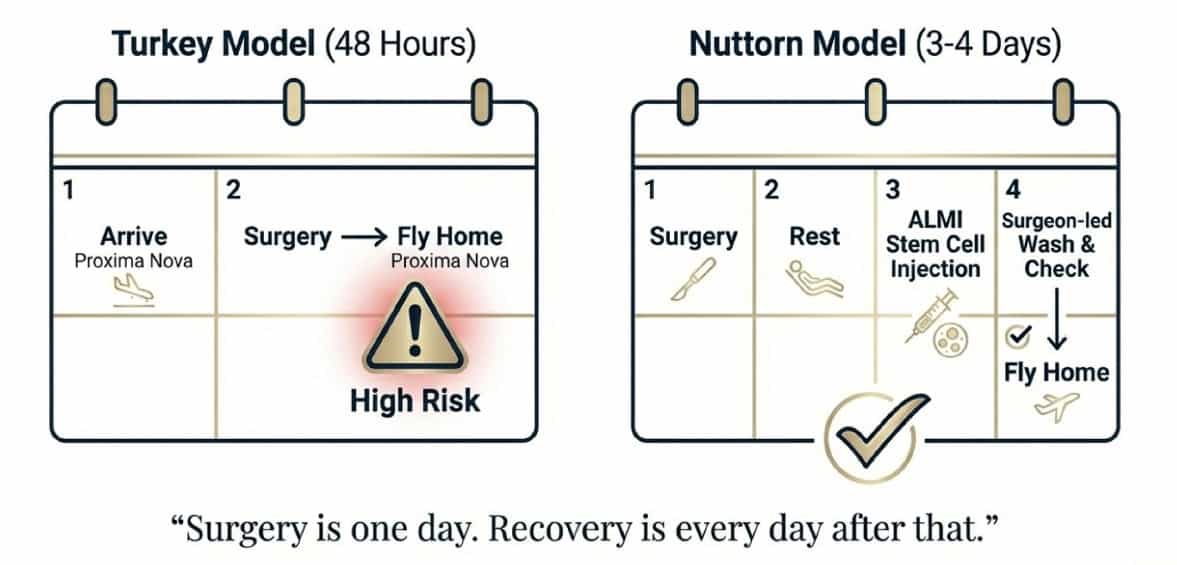
The standard Turkish hair transplant package offers approximately 48 hours in total. That includes the surgery itself and whatever recovery time remains before your scheduled departure. In practice, this means you may have your procedure on the morning of day one and be on a flight home by the evening of day two. Post-operative care is minimal, a brief check-up, a bag of medications, and instructions to contact the clinic remotely if anything goes wrong.
At Nuttorn Hair Centre, the model is fundamentally different. Our patients spend 3–4 days in Bangkok after surgery, not because recovery requires it, but because the science of the Nuttorn Protocol demands it. Here is what those additional days include:
- Day 1: First post-operative assessment, scalp cleanse, wound monitoring, swelling and medication review.
- Day 2: ALMI Nanofat Transfer, the third pillar of the Protocol, delivering regenerative stem cells directly to your newly planted grafts. No Turkish package includes this treatment.
- Days 3–4: Daily clinic visits for continued scalp cleansing, wound assessment, medication adjustment, and direct consultation with Dr Nuttorn. The nanofat is actively working within the scalp throughout, suppressing inflammation, stimulating new blood vessel formation, and nourishing grafts.
The difference is not subtle. Patients who receive 3–4 days of hands-on, surgeon-led post-operative care, combined with ALMI Nanofat’s biological support from day two, enter the independent recovery phase in a measurably stronger position than patients who were on a plane 48 hours after surgery.
Geographic Proximity: Less Time Flying, More Time Recovering
For Australian and New Zealand patients, Bangkok is roughly half the flight time of Istanbul. For patients in Singapore, Hong Kong, and across Asia, Bangkok is a short regional flight. Even for patients in parts of North America and Canada, Thailand is comparable in travel time to Turkey.
This geographic advantage has a direct clinical impact: less time in pressurised aircraft cabins during the immediate post-operative period, less jet lag affecting your sleep and recovery, and the practical ability to schedule meaningful daily consultations with Dr Nuttorn rather than relying on remote follow-up from the other side of the world.
Combined with Thailand’s renowned hospitality, world-class hotels at a fraction of European prices, exceptional food, and the genuine warmth of the Thai people, the recovery experience in Bangkok is not just clinically superior, it is genuinely enjoyable. Many of our patients describe their Bangkok hair transplant as one of the best decisions they ever made.
“Surgery is one day. Recovery is every day after that. Our commitment to our patients doesn’t end when they leave the operating room, it begins.”
— Dr. Nuttorn Narupaves, Founder, Nuttorn Hair Centre
What Prevention Looks Like After You Leave Bangkok
Our prevention programme does not end when you fly home. Beyond your 3–4 days of in-clinic recovery in Bangkok, we continue support through virtual consultations at two weeks, one month, three months, six months, and one year post-procedure. Dr Nuttorn personally reviews your progress at each milestone, ensuring your result is developing as expected and addressing any concerns immediately.
Compare this to the Turkish model, where post-operative contact is typically limited to a generic email follow-up and a WhatsApp group. At Nuttorn Hair Centre, your surgeon knows your case, your scalp, and your goals, and remains personally invested in your outcome for a full twelve months.
Frequently Asked Questions
Q: How many days should I spend in Bangkok?
A: We recommend 3–4 days after surgery. This allows time for your Day 1 post-operative assessment, ALMI Nanofat Transfer on Day 2, and continued daily clinic visits on Days 3–4 for scalp cleansing, wound monitoring, and medication reviews. This is significantly more hands-on recovery time than the 48-hour total offered by most Turkish hair transplant packages, and it makes a measurable difference to your result.
Q: What does a typical post-operative day look like?
A: First day post surgery you are asked to come in twice, once in the morning and once at night then each subsequent day you visit the clinic for a 30–60 minute session. This includes a medical-grade scalp cleanse, wound assessment under magnification, swelling evaluation, medication review, and a direct consultation with Dr Nuttorn. Any adjustments to your pain management, anti-inflammatory, or antibiotic protocol are made in real time. Between clinic visits, you are free to explore Bangkok, rest at your hotel, or enjoy the city.
Q: What post-operative complications does the Prevention pillar address?
A: The five primary risks we proactively manage are: donor area infection, excess swelling, excess bleeding, antibiotic reactions, and inadequate pain management. The vast majority of these are entirely preventable with proper monitoring and early intervention, which is why daily face-to-face consultations with your surgeon are so important.
Q: Why is 3–4 days of recovery better than the 48-hour Turkish model?
A: Most Turkish hair transplant packages include just 48 hours total, surgery and recovery combined. Patients are often on a flight home before any complications would even become visible. At Nuttorn Hair Centre, 3–4 days of surgeon-led daily care means potential issues are identified and treated immediately. Combined with ALMI Nanofat’s biological support from Day 2, our patients enter the independent recovery phase in a measurably stronger position.
Q: What medications will I need after surgery?
A: Your medication protocol is personalised based on your medical history and pre-operative allergy screening. It typically includes antibiotics to prevent infection, anti-inflammatory medication to manage swelling, and pain management tailored to your individual needs. All medications are reviewed and adjusted daily during your Bangkok recovery stay. We also provide comprehensive written documentation for your home physician.
Q: What if I have an allergic reaction to medication while in Bangkok?
A: This is exactly why thorough pre-operative screening matters. Before your procedure, we review all known allergies to antibiotics, anaesthetics, and NSAIDs. Alternative medications are arranged in advance where sensitivities are known. If an unexpected reaction occurs during your recovery stay, Dr Nuttorn is available for daily consultation and can adjust your protocol immediately, a significant advantage over managing reactions remotely from Turkey.
Q: When can I fly home after my hair transplant in Bangkok?
A: Most patients fly home 3–4 days after surgery following their final in-clinic assessment. Dr Nuttorn confirms your scalp is healing well and you are confident in your home aftercare routine before clearing you to travel. The flight from Bangkok to Australia is typically 7–9 hours, roughly 1/3rd the travel time from Istanbul, meaning less time in a pressurised cabin during the post-operative period.
Q: What follow-up care is provided after I leave Bangkok?
Q: How does ALMI Nanofat support the prevention programme?
A: ALMI Nanofat is administered at the 48-hour mark, placing its anti-inflammatory, pro-healing biological effects right in the centre of the critical recovery window. The enriched fat layer suppresses the inflammatory cascade that drives complications like swelling and shock loss, accelerates wound closure, and stimulates new blood vessel formation. Every prevention intervention is therefore working on a scalp that is actively receiving regenerative biological support.
Q: What should I avoid doing during the first week after surgery?
A: During the first week, you should avoid strenuous exercise, direct sun exposure to the scalp, swimming, alcohol, smoking, and any activity that risks contact with the treated areas. Dr Nuttorn provides detailed personalised aftercare instructions and reviews your activity restrictions during each daily consultation. These guidelines are designed to protect your grafts during their most vulnerable establishment phase.
Q: How do I wash my hair after the transplant?
A: During your Bangkok recovery stay, our medical team performs daily scalp cleanses using specialised solutions. Before you leave, Dr Nuttorn’s nursing team demonstrates the gentle washing technique you will use at home and provides clear instructions. Most patients can return to normal hair washing within 10–14 days. If you have any concerns during home recovery, virtual consultations are available.
Q: Is swelling after a hair transplant normal?
Q: What hotels do you recommend near Nuttorn Hair Centre?
A: Bangkok offers an extraordinary range of accommodation at every price point. Nuttorn Hair Centre has contracts with 3 nearby hotels ranging from World famous 5 star properties to an economy options for those on a budget. Many of our international patients stay in five-star hotels near the clinic for significantly less than equivalent accommodation in London, Sydney, or Istanbul. Our team can recommend specific hotels based on your budget and preferences, and assist with booking if needed. Thailand’s renowned hospitality makes the recovery stay genuinely enjoyable.
Q: Can I combine my hair transplant trip with a holiday?
A: Many patients do exactly this. After completing your 3–4 day recovery programme in Bangkok, you are free to travel within Thailand or the broader region. Beach destinations like Phuket and Koh Samui are a short flight from Bangkok, and many patients extend their trip by a week to combine world-class medical care with a memorable holiday. Just be mindful of sun exposure guidelines for the treated area.
Q: What makes Nuttorn Hair Centre’s aftercare better than other Bangkok clinics?
A: The difference is systematic integration. Our aftercare is not a standalone service, it is the fourth pillar of a protocol designed so that each component reinforces the others. ALMI Nanofat provides biological support from Day 2. Daily surgeon-led consultations provide clinical oversight. And everything operates within a framework refined across 22 years and more than 10,000 procedures. No other hair transplant clinic in Bangkok or Thailand offers this level of integrated post-operative care.